
In 2026, ambient AI technology is changing clinical workflows by reducing administrative workload and improving providers’ satisfaction.
Most healthcare providers choose medicine because they want to take care of patients, not to devote their time to documenting every patient’s notes. Yet recording and managing patient information has become a major responsibility for many clinicians. Often prolonging workdays, contributing to burnout, and takes valuable time away from patients. Because healthcare organizations find solutions to decrease administrative burden while maintaining a high standard of care, ambient clinical documentation is standing as a strong solution. By managing much of the documentation process automatically, it facilitates clinicians to focus on meaningful patient interactions rather than manual work.
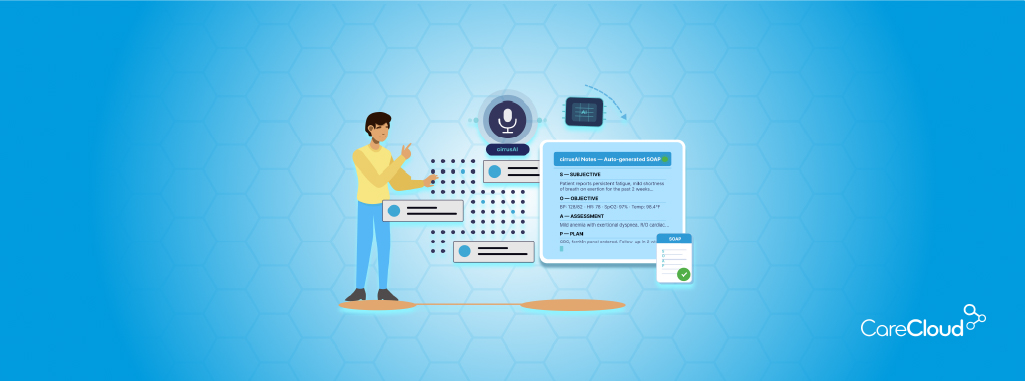
Driven by recent advances in Artificial intelligence, an ambient clinical documentation tool can capture conversations with patients, then turn them into structured clinical notes, and automatically add them to Electronic Health Records (EHRs). Despite spending time creating patient notes manually, physicians can stay entirely involved in the conversation with the patient, and AI takes care of much of the notes in the background.
Why Physicians Spend Half Their Day on Documentation
Documentation has become one of the most time-intensive parts of healthcare. Between recording patient notes, updating charts, handling coding requirements, and meeting regulatory requirements. Providers often spend nearly as much time documenting care as they do deliver it.
Many physicians find themselves completing charts after clinic hours. As compliance requirements and electronic health records (EHR) workflows have grown increasingly complex, the physician’s documentation burden has gradually increased. This makes it hard to stay productive without working beyond the end of the day.
The traditional documentation method frequently switches repeatedly between engaging patients and data entry. Although voice-to-text tools in electronic health records (EHRs) have minimized the need for typing, they still require physicians to manually record notes and then structure the information once it is done.
As patient volume rises and staffing challenges continue, healthcare organizations are finding ways to decrease administrative workload while maintaining accurate medical records. This demand has driven faster technology adoption like AI medical scribes and automated documentation platforms.
What Ambient Clinical Documentation Actually Means:
Ambient clinical documentation is described as AI-powered technology that listens to patient conversations automatically and makes clinical notes. As opposed to a traditional dictation tool, the ambient system runs silently in the background without the need for a physician to manually speak out every detail.
- They use advanced speech recognition and natural language processing (NLP) to capture and analyze provider–patient communication
- Identifies clinically relevant information and converts it into standardized AI-generated clinical notes for clinician review.
- Understands clinical context to create structured documentation, including automated SOAP notes, assessments, treatment plans, and follow-up recommendations.
- Reduces documentation burden, allowing clinicians to focus on patient-centered interactions and clinical decision-making.
How AI Captures Notes Without Disrupting the Visit
Step 1 – Ambient listening during the encounter:
During the visit, the ambient documentation system securely listens to the conversation between the providers and the patient. Using advanced AI, detect important clinical details while removing unnecessary parts of the discussion. By this, providers can maintain eye contact and engage more naturally with the patient without disturbing the conversation to document information.
Step 2 – AI generates a structured SOAP note:
Once the conversation is done, the AI gathers the information into clear and structured clinical notes. It creates automated AI SOAP notes, summarizes key findings, documents for clinical assessment, and develops treatment plans based on the discussion. This helps clinicians complete EHR note generation more smoothly while making sure that records remain accurate and consistent.
Step 3 – Physician reviews and approves in seconds:
Before the information is added to the patient’s chart, the physician reviews the AI-clinical note to verify that it accurately captures the visit. Any important changes can be made quickly, and the note is finalized before entering the EHR. This review step keeps physicians in control of the documentation process while helping maintain clinical accuracy and physician review.
Ambient Scribing vs Traditional Transcription: Key Differences
|
Feature |
Traditional transcription |
Ambient scribing |
| Documentation timing | Created after the patient encounter | Created during the patient encounter |
| Process | Requires dictation or transcription after the visit | Captures information automatically in real time |
| Note Generation | Requires manual review and editing | Generates structured clinical notes automatically |
| EHR Integration | May require additional formatting | Can be integrated directly into EHR workflows |
| Administrative Burden | Higher due to dictation and editing | Lower due to automated documentation |
| Provider Focus | More time spent on charting | More time spent on patient care |
| AI Medical Scribe Capability | Not available | Captures, analyzes, and documents encounters automatically |
| Patient Experience | Potentially interrupted by note-taking | Supports more patient-centered interactions |
What to Look for in an AI Documentation Tool
Not all AI platforms are alike, so healthcare organizations should choose solutions that work well within existing workflows, how precise the clinical output is, how easy it is to use, and the security of data. The right solution can enhance day-to-day efficiency while making a more supportive experience for clinicians. An important factor is how smoothly the tool integrates with current EHR workflows. The strongest solution allows providers to create notes within EHR, by removing the need to switch between multiple systems. This helps in reducing interruptions during clinical practice.
Accuracy is equally important, providers need to trust that AI clinical notes truly reflect the patient encounter and clinical decision-making process. A solid physician review and validation process also contributes to maintaining quality, safety, and compliance. Security and compliance should remain key priorities, with organizations making sure that patient data is secured through HIPAA-compliant safeguards and secure access controls. Eventually, the right solution should improve efficiency without complicating workflows or increasing the administrative load on clinicians.
How cirrusAI Notes Works Inside CareCloud’s EHR
CareCloud’s cirrusAI platform brings ambient clinical documentation directly into the provider workflow through cirrusAI Notes. Rather than requiring physicians to move between different applications, it functions within the CareCloud ecosystem to streamline documentation from start to finish. During the patient visit, cirrusAI Notes records important clinical information and automatically turns it into structured documentation. Providers receive clear, well-organized notes that fit naturally into their clinical workflow and can be quickly reviewed before finalizing.
Because cirrusAI in CareCloud’s EHR environment is fully embedded, providers can move from patient interaction to completed documentation more effictively, with less friction and fewer steps. This helps to minimize interruptions and creates a smoother, more efficient workflow throughout the day. Most importantly, cirrusAI Notes save 20% of documentation time per day, giving physicians back valuable hours they can use for patient care, practice growth, or better work-life balance. By minimizing administrative work, CareCloud supports higher provider satisfaction and better overall practice performance.
Frequently Asked Questions
1: Is ambient AI documentation HIPAA compliant?
Yes, Ambient AI documentation is designed to support HIPAA compliance through safeguards of data, access control, activity logs, and protected storage. Healthcare organizations should make sure that any solution they implement fulfills HIPAA requirements and aligns with their internal security and compliance standards before integration.
2: Does the AI work for all specialties?
Most modern ambient documentation platforms cover an extensive range of medical specialties, which includes primary care, internal medicine, cardiology, orthopedics, pediatrics, and others. However, its performance can depend on specialized medical terminology, so organizations should assess how well a solution fits their unique clinical workflows and documentation requirements.
3: How Valid are AI-generated clinical notes?
AI-generated clinical notes can be highly accurate when they are trained in medical language and real clinical workflows. Yet, physician review is still an important step. Ambient documentation tools help make the note-taking process faster, but providers are ultimately responsible for checking the information and making sure it is right before it is added to the official medical record.
4: Can the physician review and edit the note before it is uploaded to the EHR?
Yes. Ambient clinical documentation systems are built with physician oversight at the center. Providers can review, edit, and finalize notes before they are saved to the EHR. This allows clinicians to modify details, add context that is missing, and make sure the documentation truly reflects the patient’s encounter and clinical decisions.